Technical interview practice for the conversation round
Technical interview practice often includes more than a coding task. You may need to explain a system, defend a trade-off, walk through a project, or answer a follow-up when a design choice creates a constraint.
Product guidance maintained by the Openskill team · Updated September 3, 2026
Technical interview practice should match the round you will face: coding for implementation, system design for architecture, project discussions for depth, and behavioral questions for collaboration. Openskill concentrates on the spoken parts: explaining choices, constraints, failures, and trade-offs under follow-up questions.
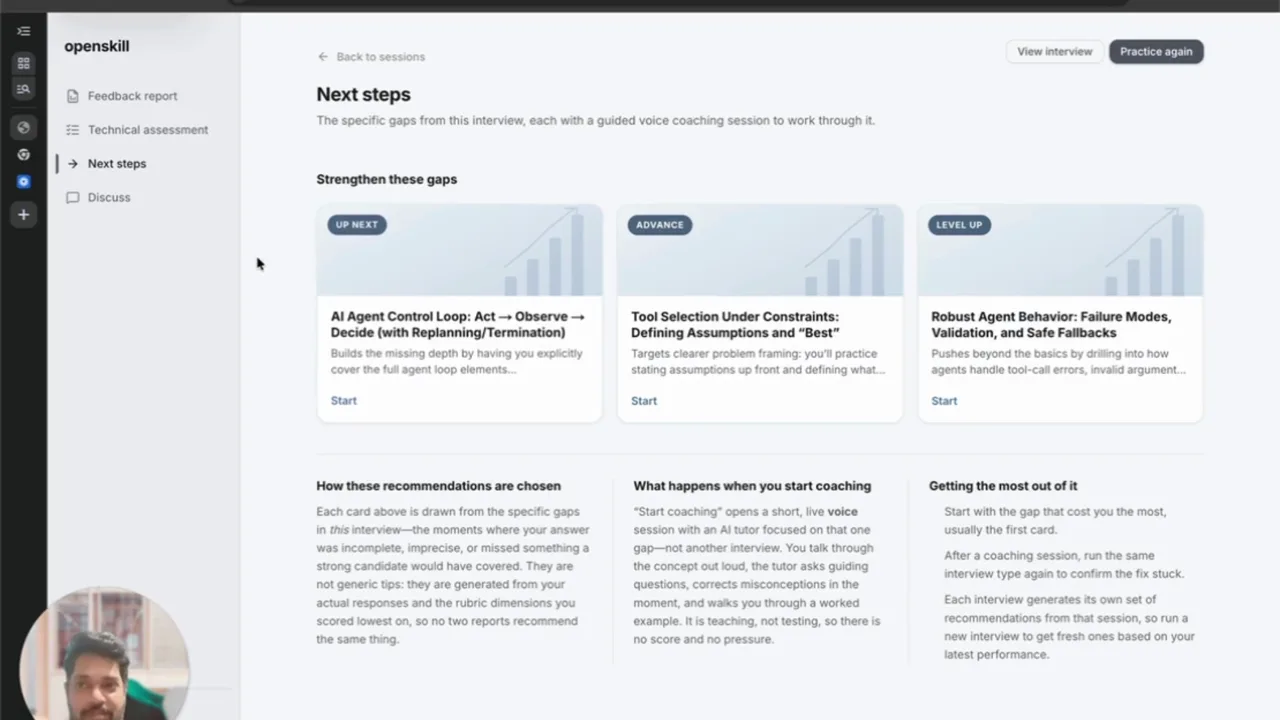
A real Openskill report turns a completed voice interview into scored feedback and concrete next steps.
Practice with context
Explain the technical decision under follow-up.
Openskill covers technical interviews in the library and lets you create a session from the role, level, and job description you have in front of you.
Practice the explanation around the build
Technical rounds often ask for the reasoning around a choice: why this design, how it fails, what you would measure, and what you changed after the first version. System design interview practice gives those answers room to develop in a spoken conversation.
Choose technical topics with context
The library includes technical tracks across AI and machine learning engineering, data, MLOps, systems, security, and related roles. A custom interview can use the language of the job description you pasted.
Review the answer at question level
For question-and-answer sessions, the report lets you jump between question chapters, read the scoring rationale, and compare your response with a strong answer. Use the recording to hear whether the explanation stayed clear.
A sample question
A system answer needs constraints and a trade-off.
How would you design a service that needs to stay responsive as traffic changes?
This is the kind of opening prompt you can practice in a live session.
What to cover
Start with the user need and constraints. Choose a design, explain the trade-offs, name how you would measure it, and describe the failure mode you would test first.
Pick the role and level
Start in the technical library or create a custom interview.
Explain the trade-offs aloud
Work through projects, systems, and technical decisions in a live session.
Target the next question
Use the report to choose the technical topic for your next practice interview.
Good prompts to practise
Example technical interview practice questions
Which constraint determines the architecture you would choose?
Where does this design fail first as traffic grows?
Tell me about a production issue you diagnosed and fixed.
Why did you reject the most obvious alternative?
Use it deliberately
Who this practice is best for
Project deep dives and technical decision explanations
System and ML design conversations with follow-ups
Practising concise technical communication before a panel
Questions
Questions about technical interview practice.
Can I use Openskill for technical interview practice?
Yes. Openskill has curated technical interviews and accepts a custom role or job description. It is suited to the spoken parts of technical hiring, including project discussions, system reasoning, and follow-up questions.
What happens after a mock interview?
Sessions longer than three minutes receive a scored feedback report. It includes strengths, areas to improve, communication signals, a recording with chapter markers, and question-by-question feedback when the format uses questions and answers.
Can I practice for a role from a job description?
Yes. Paste a job description, a job posting URL, or a plain-language description into Openskill. You can review the generated interview before you begin, and custom interviews stay in your library for another attempt.