Tell me about yourself
Answer with a relevant professional story: where your experience started, the work that best matches this role, and why this next step makes sense. Keep the answer focused enough to invite a useful follow-up.
Job interview questions and answers
Useful job interview questions and answers help you build an original response. They show what the interviewer is trying to learn, which evidence belongs in the answer, and which follow-up details you should be ready to explain.
The short answer
Answer the question directly, choose one relevant example, make your own action visible, and connect the result to the role. For behavioral questions, a short STAR structure helps. For motivation or fit questions, use specific evidence from the role and organisation rather than generic enthusiasm.
Practice with context
Use the examples below as starting points, then create an Openskill interview from the actual job description so the questions and follow-ups reflect the role you want.
Answer with a relevant professional story: where your experience started, the work that best matches this role, and why this next step makes sense. Keep the answer focused enough to invite a useful follow-up.
Connect specific responsibilities to evidence from your past and a direction you genuinely want to pursue. Mention the organisation only when you can point to something concrete about its product, customers, or way of working.
Choose a real, manageable development area. Explain how it affected your work, the action you are taking, and the evidence that your approach is improving. Avoid disguising a strength as a weakness.
A sample question
This is the kind of opening prompt you can practice in a live session.
Give a brief professional through-line, two experiences relevant to this role, and the reason this opportunity is the logical next step. Avoid a full biography or a list of every job.
Identify the responsibilities and evidence the interviewer is likely to test.
Match each common question to a real experience rather than a memorised script.
Complete a voice interview, review the recording, and prepare the likely follow-up.
Good prompts to practise
Use it deliberately
Questions
It depends on the question. A direct factual answer may take under a minute, while a behavioral example may need two or three minutes. Lead with the answer, keep context short, and let the interviewer ask for more detail.
Memorise the evidence and structure, not exact sentences. A word-for-word script can sound brittle and makes follow-up questions harder. Practise several natural versions of the same story.
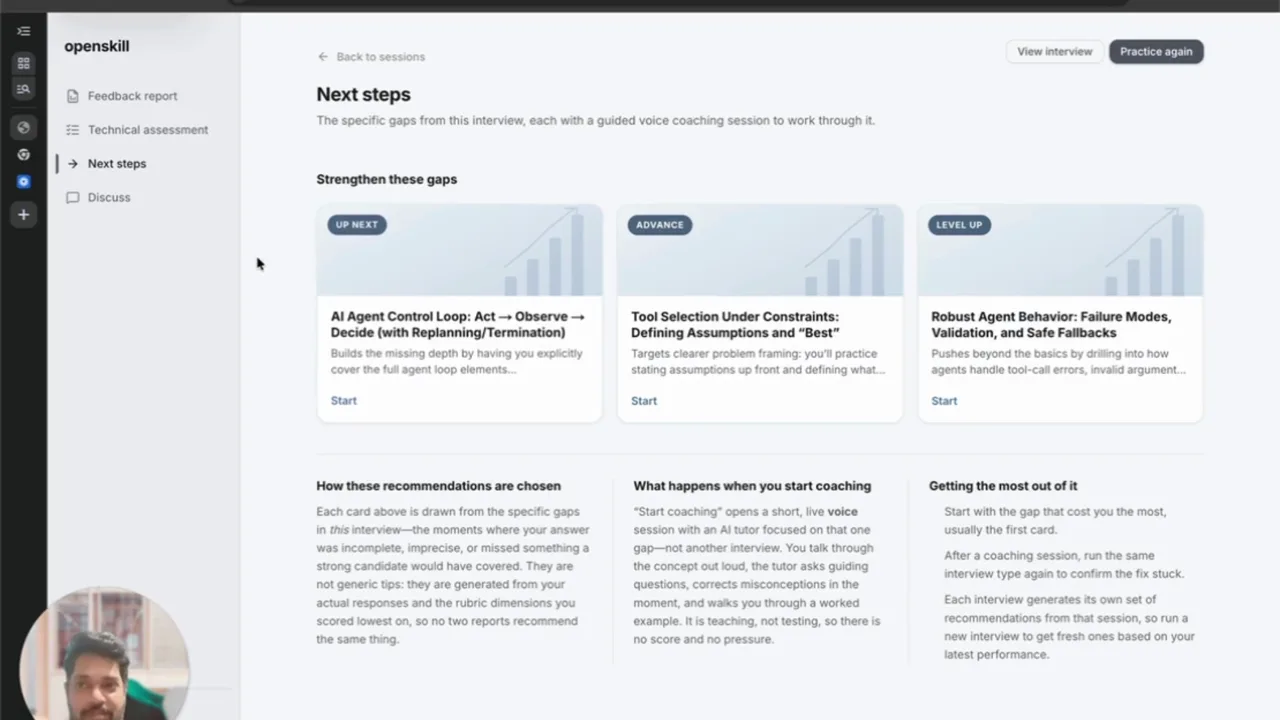
Sessions longer than three minutes receive a scored feedback report. It includes strengths, areas to improve, communication signals, a recording with chapter markers, and question-by-question feedback when the format uses questions and answers.
Yes. Paste a job description, a job posting URL, or a plain-language description into Openskill. You can review the generated interview before you begin, and custom interviews stay in your library for another attempt.
Independent guidance
Use these external guides alongside voice practice when you want another perspective on interview preparation.