Clarify the decision
Ask what success means, whose decision you are supporting, the relevant time horizon, and any constraints. The same facts can imply a different analysis when the objective changes.
Case interview practice
Case interview practice helps you make a complex business problem smaller, choose the analysis that matters, update your view as evidence arrives, and communicate a defensible recommendation.
The short answer
Practise cases by clarifying the objective, structuring the problem into distinct branches, prioritising the first analysis, doing the necessary maths, and synthesising a recommendation. A voice session rehearses the conversation and follow-ups, while paper or a spreadsheet can support exhibits and calculations.
Practice with context
Create a practice session for consulting, product, strategy, finance, or management and specify the case type, experience level, industry, and skills you want the interviewer to probe.
Ask what success means, whose decision you are supporting, the relevant time horizon, and any constraints. The same facts can imply a different analysis when the objective changes.
A structure is useful only if it guides action. Explain which branch you would test first, what evidence would support it, and why that answer matters to the overall recommendation.
Pause after new evidence to say what changed and what remains uncertain. End with a clear recommendation, supporting reasons, material risk, and the next step you would take.
A sample question
This is the kind of opening prompt you can practice in a live session.
Clarify the objective and time period. Separate revenue and cost drivers, prioritise the largest uncertainty, request the evidence you need, and finish with a recommendation plus risks.
Transparent evaluation
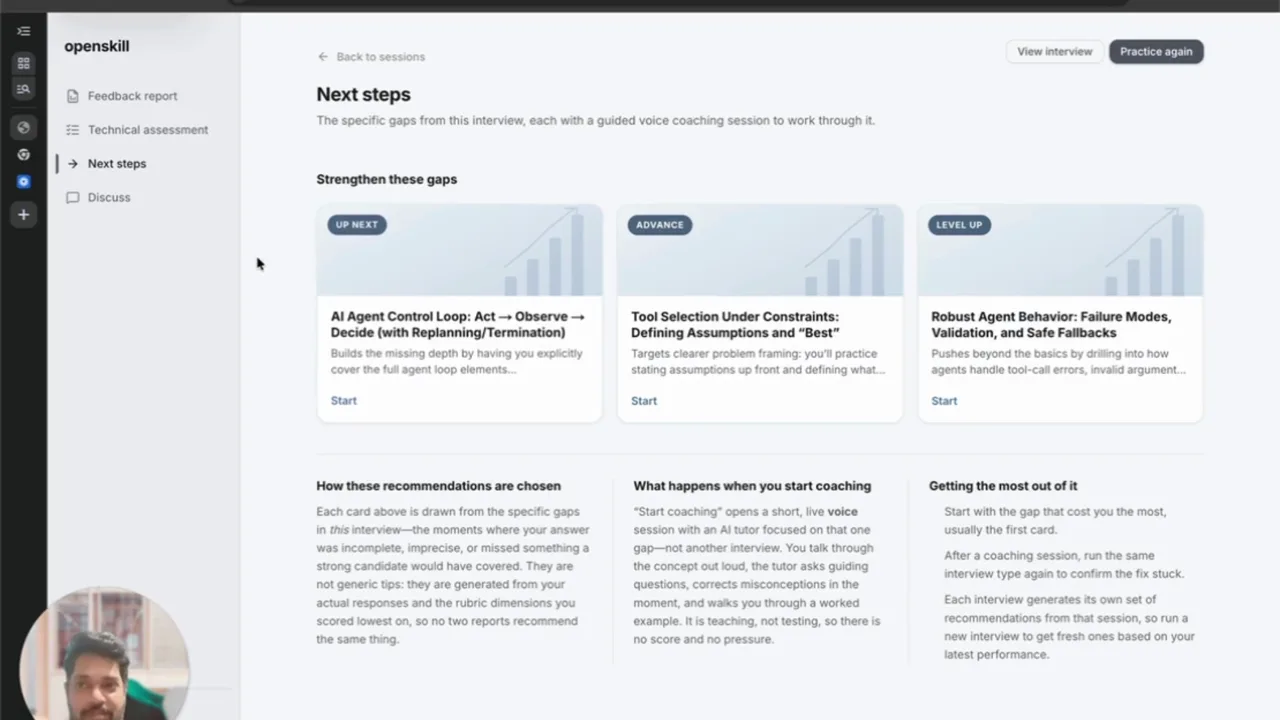
The feedback report turns the conversation into concrete criteria you can review before another attempt.
Did you divide the problem into useful, non-overlapping drivers?
Did you explain which uncertainty or calculation should be tested first?
Did you use the available facts and calculations accurately?
Did you update the approach when the interviewer introduced new evidence?
Did you finish with a recommendation, supporting reasons, risks, and a next step?
Define the role, industry, case type, and level of difficulty.
Clarify, structure, analyse, and update your view as the interviewer follows up.
Replay the recommendation and practise the weakest transition again.
Good prompts to practise
Use it deliberately
Questions
Work through calculations on paper or in a spreadsheet during the voice session, then explain each assumption and conclusion aloud. This combines quantitative practice with the interviewer dialogue and synthesis.
Sessions longer than three minutes receive a scored feedback report. It includes strengths, areas to improve, communication signals, a recording with chapter markers, and question-by-question feedback when the format uses questions and answers.
Yes. Paste a job description, a job posting URL, or a plain-language description into Openskill. You can review the generated interview before you begin, and custom interviews stay in your library for another attempt.
Independent guidance
Use these external guides alongside voice practice when you want another perspective on interview preparation.